
This deep-dive article is a companion to Dan Lake’s Be Curious paper, Embracing Experimentation: Why your best employees are afraid to try new things (and what to do about it). It explores some of the developmental research and organizational data that supports the shift from expertise-driven models to an experimentation-first culture.
Helping your people navigate the shift to experimentation-led culture.
Most performance systems were designed on the foundation of rewarding people for being ‘right’. Now, with organizational transformation becoming essential to staying competitive, we’re asking people to be comfortable being uncertain, and experiment to find their way forward. This change can require a fundamental identity shift for your best employees.
As Dan Lake, Global Head of Delivery at Adeption, explains in his paper Embracing Experimentation, the resistance we often see isn’t laziness. It’s a survival mechanism for people who have built their professional worth on mastery, expertise and results.
The identity threat facing your best people
For high-performers, experimentation doesn’t just feel like a new task, it can feel like a risk to their professional standing. When your value has been tied to having the ‘right answer’ for years, being asked to test an unproven idea can be alarming. That’s why many experts unconsciously perceive the shift toward experimentation as a threat rather than an opportunity for transformation.
Navigating this tension requires more than a shift in perspective; it requires the developmental pressure of a ‘Heat Experience’ – situations that force us out of our comfort zone. While our research shows 28.6% of leaders credit Heat Experiences as the greatest contributor to their growth (1), they’re inherently uncomfortable situations. But this discomfort is non-negotiable. Transformation is impossible without the willingness to experiment and the courage to face the uncertainty it brings.
Behind the Research
The Embracing Experimentation synthesis is derived from over a decade of longitudinal research and organizational practice:
Methodology: The paper integrates Robert Kegan’s foundational work on adult development, Ron Heifetz’s adaptive leadership principles , and Adeption’s Be Conscious, Be Curious, Be Better (B3) Methodology.
Direct observation at scale: This synthesis is informed by Adeption’s work with over 1OO,OOO leaders globally, including experiment-based leadership initiatives within Fortune 5OO firms such as Salesforce, Workday, and Aurecon.
From teaching skills to structuring growth
The role of L&D in organizations is shifting. It’s no longer just about teaching technical skills or managing the mechanics of change. It’s about engineering the environments where new levels of mental complexity can emerge. Mindset growth is not an overnight process – it often takes years – but our data indicates that deliberate, structured intervention accelerates this evolution..
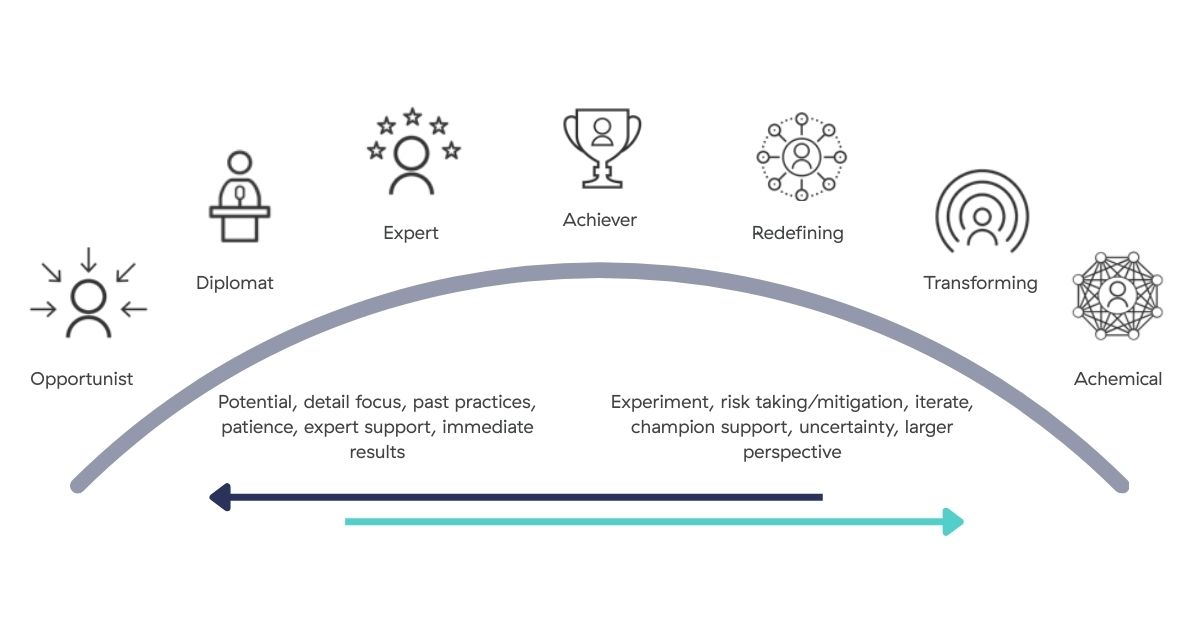
Our analysis showed that 51.4% of participants who started an Adeption leadership development program with an earlier mindset ‘center of gravity’ were able to add a new mindset to their range during the experience (2). These leaders were able to flex into the Redefining and Transforming stages of adult development – the specific mindsets that better support leading through the uncertainty of experimentation.
A roadmap for talent leaders
To operationalize this shift for Learning Leaders, Dan Lake’s paper provides a systemic implementation roadmap to embed a true culture of experimentation:
- Redefine success as learning: Reward insights extracted from failed experiments.
- Create a ‘Don’t’ list: Actively stop activities that reinforce old, rigid habits.
- Establish a questioning framework: Give explicit permission to question timing, processes, and standard approaches.
- Define acceptable loss: Set clear boundaries on where it is safe to test and where standards are non-negotiable.
Download the paper for the 24-month implementation roadmap.
Moving from a culture of expertise to one of experimentation is more than a tactic; it’s a developmental evolution. It requires people to trade the comfort of being right, for the growth that comes from being uncertain and finding new solutions. Ultimately, organizations don’t experiment – people do. The job of Learning Leaders is to build the scaffolding that makes that evolution not just possible, but safe.
How B3 fuels experimentation
While the ‘Expertise Trap’ creates a barrier to transformation, Adeption’s B3 Methodology provides the scaffolding leaders need to move through it. Here is an example of how this simple, three-step cycle could be used by an individual to move towards an experimental mindset:
- Be Conscious: Notice when you are ‘protecting’ your expertise. By naming the moment you feel defensive or resistant to a new idea, you can gain immediate awareness of the ‘Identity Threat’ – often indicating an opportunity for growth.
- Be Curious: Replace your initial reaction (judgment) with a question. By asking, “What would have to be true for this to succeed?” or “Who might help me understand this?” you effectively shift your professional value from ‘having the answer’ to ‘finding the solution.’
- Be Better: Commit to a micro-experiment – such as a small, low-risk change to a routine or meeting – and reflect on the outcome. It is the repeated habit of this B3 cycle, rather than a one-time event, that builds the mental muscle for continuous developmental growth through experimentation.
Key Concept – Leadership Development Mindsets
Frequently Asked Questions
Why do high-achieving employees often resist experimentation?
Our research into leader development suggests that resistance is frequently tied to professional identity. For many high-achievers, their perceived value has been built on ‘Expert’ status. In this context, the uncertainty inherent in experimentation can feel like a threat to their established credibility rather than a growth opportunity.
What is the ‘Fail Fast Fallacy’? It’s when a company tells people to take risks but continues to reward perfection and hitting targets above all else. Without changing the reward systems, ‘fail fast’ is just a slogan, not a culture.
What are the developmental stages of an experimentation mindset? Adult development theory, specifically the work of foundational thinker Robert Kegan, identifies mindsets like Expert and Achiever (focused on results) and Redefining and Transforming (focused on systems and possibilities). People who can access Redefining and Transforming mindsets are more likely to lean into experimentation.