
Why is it that organizational change initiatives so often fail? Why do some leaders quickly adapt in the face of disruption – while others struggle to lead their teams forward?
In a world that’s rapidly changing, applying yesterday’s leadership playbook isn’t effective when navigating new and complex challenges. These types of challenges – such as the disruption brought about by AI – don’t respond to established best practices or expert frameworks. Instead, they require a fundamentally different approach.
In 2O25, in response to this rising need, Adeption invited leaders across all sectors globally to apply for scholarships to an open ‘Adaptive Leaders of Tomorrow’ development experience (now called Adaptive Leaders). Designed to grow adaptive leadership capacity in mid-level and senior leaders, this three-month program took participants through a development experience grounded in the same methodology and practices Adeption uses with its Fortune 5OO clients. The leaders who were selected to participate say it’s had an immediate and powerful impact on their leadership.
In this article, we unpack some of the key principles covered in the experience, with direct insights from participants.
Leading today means navigating complexity
Adeption Co-founder and CEO Carl Sanders-Edwards says the pace of change and level of complexity leaders are facing today is being felt globally, across all sectors.
“We’re seeing a sharp rise in demand from organizations wanting to build adaptive leadership capacity – and fast. Many are going through business transformations, requiring a different kind of leadership, while others are looking to lift leadership capacity in response to a rapidly changing context.
“One of the fundamental skills leaders need today is the ability to differentiate between Technical and Adaptive challenges – and apply the right approach. Technical challenges have been solved before; it’s a matter of bringing in the expertise or using the best framework. It’s not necessarily simple but there is a best practice to apply. Adaptive challenges are new and complex. Getting to a solution is an iterative process, where you run experiments and collaborate with those involved to learn, unlearn and make progress. This can take more time and effort, but you get solutions that stick — saving time and resources in the long run”.
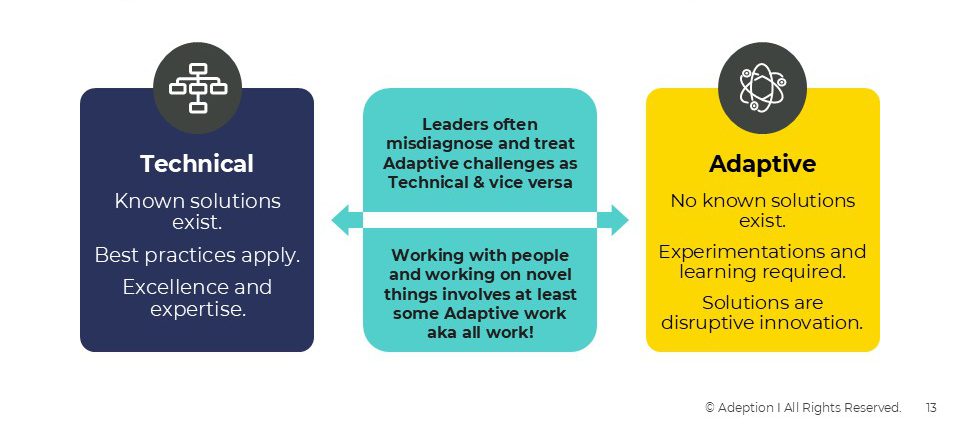
Participants in the Adaptive Leaders experience made progress on the real challenges in front of them, and as well as being a development experience, it directly helped them navigate their way forward on current priorities.
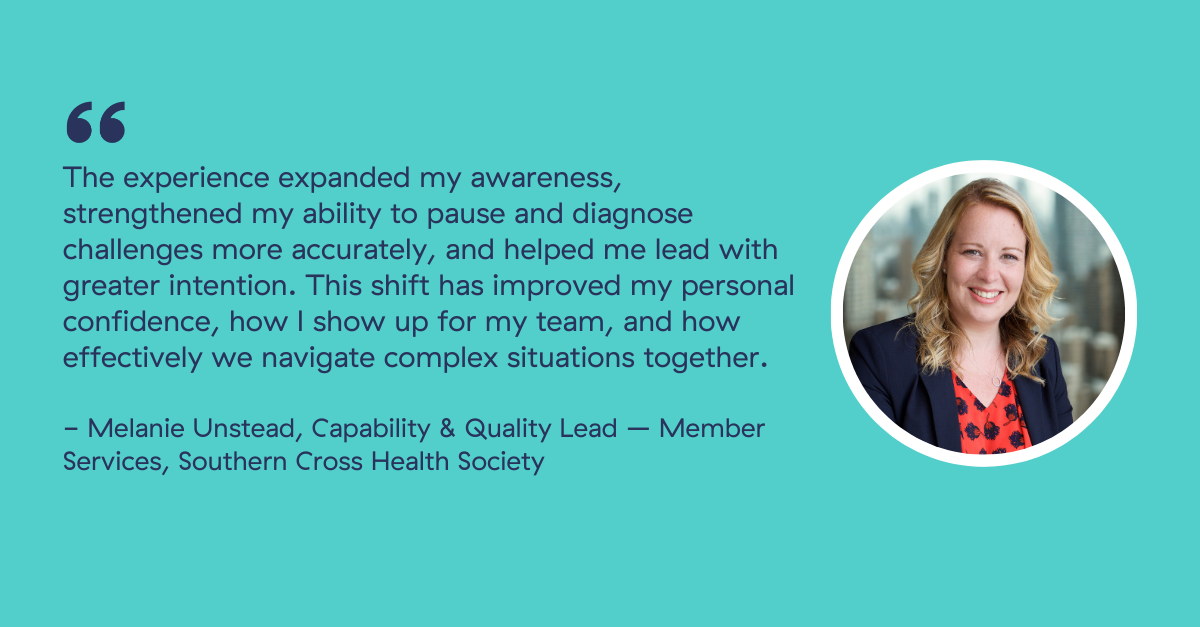
As one participant, Melanie Unstead, Capability & Quality Lead – Member Services at Southern Cross commented: “Distinguishing between technical and adaptive challenges changed my approach. I had been treating most issues as technical ones and becoming frustrated when solutions didn’t stick. Recognising the difference helped me adjust my strategies, which created meaningful change for me and my team”.
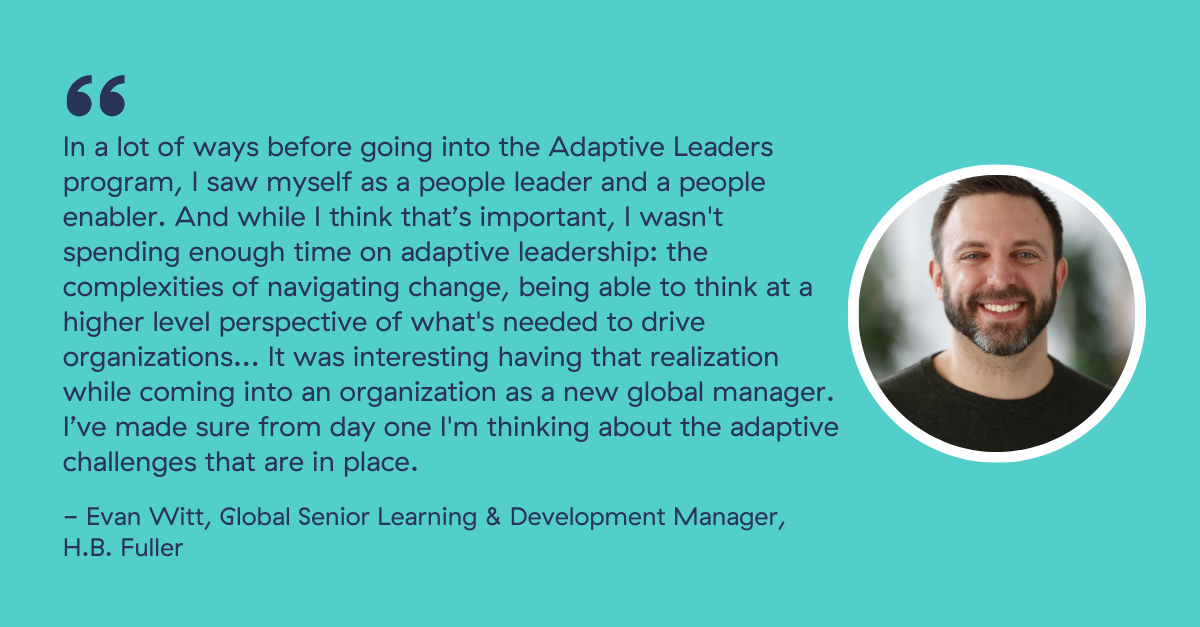
Evan Witt, Global Senior Learning & Development Manager at H.B. Fuller completed the program while navigating a job change – giving him a unique perspective:
Developing a motivating purpose as a leader is vital
Leading in today’s fast-changing world can be demanding. As Carl-Sanders Edwards explains “You need to be leading because of a deep sense of purpose. It sounds a touch dramatic, but when we talk about leading through adaptive challenges it’s critical to understand your ‘why’ as a leader, because often the external rewards aren’t enough of a driver – it’s got to be coming from within”.
This perspective resonated strongly with participants in the program, who completed a ‘Leadership Line’ to reflect back on their past experiences, look ahead to the future, and take ownership of the overarching narrative of their careers and lives.
For Melanie, the program led to a significant shift: “As I went through the program, I realized I wasn’t just a ‘doer’ anymore. I wanted to make a bigger difference. The program gave me the language to say, ‘I’m ready for growth’ and to align my daily actions with a larger transformation”.
Adaptive leadership means moving into Explore mode
When it comes to navigating adaptive challenges, the work that needs to be done sits between formal areas of authority. This means you literally need to take ‘leadership’ to step beyond what is expected or ‘authorized’. The new and unknown nature of these challenges also means it’s difficult to assess whether you’re making progress on them.
As Carl explains: “You’re very much in the grey space and need to experiment, much like an entrepreneur. The mental framing leaders often find helpful is to pause and ask themselves ‘Am I in Explore mode or Protect mode?’ and to move into Explore mode as much as possible.
Adeption’s three-step Be Conscious, Be Curious, Be Better (B3) methodology is integrated throughout the Adaptive Leaders program, giving participants a simple, repeatable framework to navigate adaptive challenges in ‘Explore mode’ while at the same time developing the meta skill to learn how to learn. 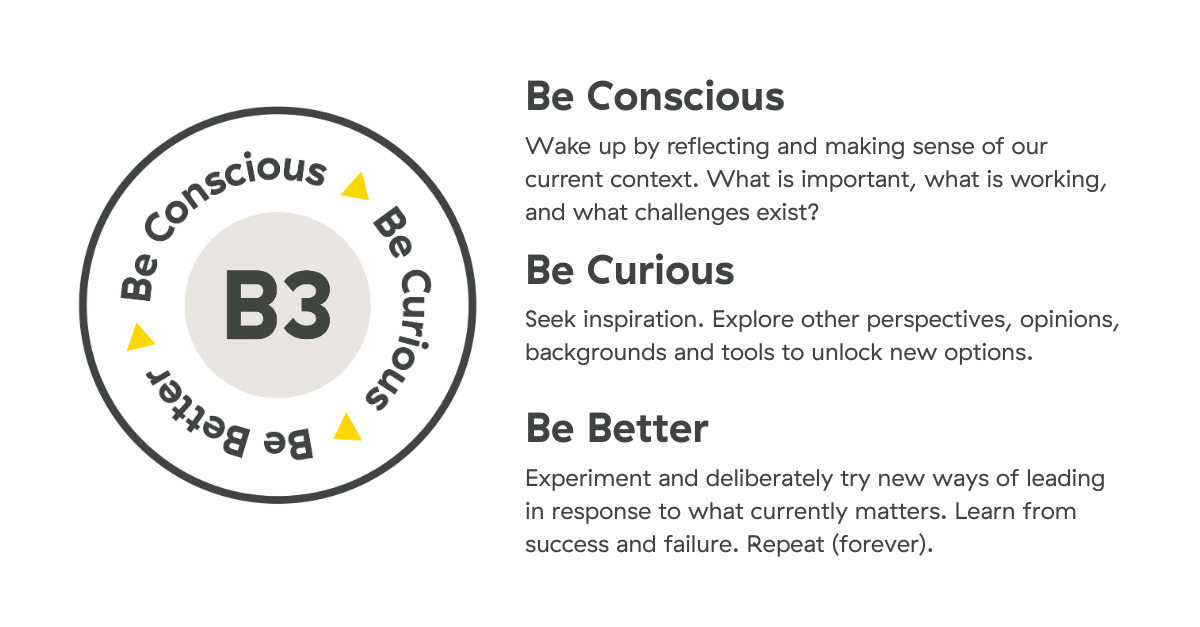
On-the-job experiments set by participants during the program ranged from practicing self-awareness and composure (48 percent of actions connected to this theme) to being more intentional in identifying and creating space for long term priorities (3O percent of actions).
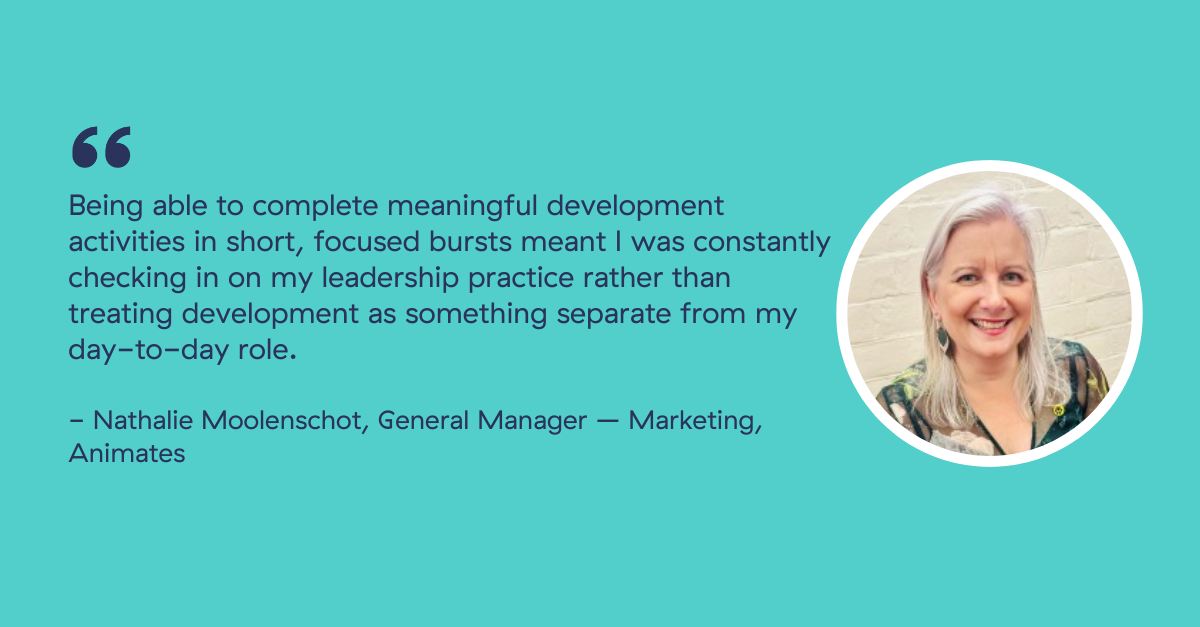
Nathalie Moolenschot, General Manager – Marketing at Animates found the micro loops of B3 particularly effective:
Effective leaders grow adaptive mindsets
Adeption’s B3 methodology also fosters the core conditions required for leadership mindset development (vertical development), which include heat experiences, colliding perspectives, and deliberate reflection. Over time, exposure to these conditions helps leaders grow their range of leadership mindsets, giving them the ability to intentionally flex and respond more effectively in different situations.
“One of the most valuable insights came from the mindset work, particularly the Leadership Mindset Indicator. It gave me a clear, practical lens to understand how my default leadership patterns show up under pressure, and how those patterns can either enable or limit my effectiveness when leading change,” says Nathalie.
Adaptive Leadership with Adeption
Adeption is now making Adaptive Leaders experiences available to clients, with both micro (4 and 8 hour options) and deep-dive experiences to choose from. Easy to customize and quick to deploy, they offer an immediate pathway for organizations wanting to lift adaptive leadership capacity while seeing direct ROI.
For Melanie, the Adaptive Leaders journey unlocked a new level of growth.
Evan agrees the time invested delivers strong ROI: “The Adaptive Leaders experience will provide you with the framework, skills, and community needed to push you towards finding solutions to your organization’s biggest challenges. While it is a commitment, the time invested in this experience will help you achieve better and faster future results,” he says.
View Adeption’s current Adaptive Leadership offerings
What is adaptive leadership?
One of the biggest mistakes leaders make is trying to address complex challenges with a Technical rather than an Adaptive approach, wasting both time and effort. Adaptive leadership takes a collaborative, experimental and iterative approach to navigating through complex and evolving challenges. It is grounded in work by Ronald Heifetz and colleagues at Harvard University.
Diagnosing leadership challenges
A critical first step when dealing with a new, tough challenge is diagnosing it as either technical, adaptive, or a combination (‘bundled’), order to apply the most effective leadership approaches:
- Technical challenges are clear cut. They have been dealt with before and require expertise or best practices to solve. If we can teach someone how to tackle a challenge, then it’s a technical one.
- Adaptive challenges are more complex, often involving many actors and parties with a stake, and sometimes ‘blurry’ causes and effects. There are no known solutions. Understanding and moving through these challenges requires pausing to diagnose the challenge correctly and invite diverse perspectives, then moving quickly to action by creating space for collaboration and experimentation.
- Bundled challenges have both technical and adaptive parts, each of which need to be approached accordingly.
Adaptive leadership practices
When dealing with adaptive challenges, there are several practices leaders should implement to move towards solutions:
- Get on the balcony: When navigating a new challenge, start by briefly stepping back to get a broad, strategic view of the situation. This includes seeking to understand the dynamics at play and root causes. With more clarity, you can figure out if the challenge you’re looking at is adaptive, technical, or more likely a combination of both, and apply the right approaches.
- Enlist and collaborate: Once you’ve identified a challenge as adaptive, enlist those involved in the challenge in working through it. With adaptive challenges, no one person has all the answers, so collaboration is key to getting to solutions.
- Run experiments to learn through doing: Developing a large-scale, detailed plan upfront, and attempting to implement it in full, is a recipe for failure when tackling adaptive challenges. Instead, experiment with lots of small interventions or prototypes, assess results, and course correct as you go. As well as moving you towards solutions, experiments often help you understand the situation better — similar to throwing stones into a pond and watching the shape of the waves to understand what’s below the surface.
- Reflect to learn and innovate: Deliberate reflection allows you to learn from the results of your experiments, refine and iterate your approach, and gain new insights, leading to solutions.
Adeption’s Be Conscious, Be Curious, Be Better methodology is built to support these processes. It provides leaders with a simple and practical framework to navigate adaptive challenges and share with their teams – helping leaders grow their capacity in the process..